
Painting a Brick House Exterior: A 120-Year-Old Denver Case Study
Yes, you can paint a brick house exterior. What makes it last is the prep: brick only holds paint when the surface is sound, conditioned and sealed with a masonry primer first. We saw exactly what happens when those steps get skipped on a 120-year-old home in Downtown Denver. Here's the whole story.
The home is in Downtown Denver and has been standing for more than 120 years. Other painters had worked on it before us. It probably looked great the day they packed up, but they didn't follow the right steps for brick, and by the time our team arrived, the paint had failed on every wall.
This is how we brought it back, what we'd tell anyone thinking about painting a brick house exterior, and what a job like this really takes.
The House: A 120-Year-Old Brick Home in Downtown Denver
It's a two-story brick Denver Square with wide eaves, carved corbels under the roofline, dentil molding and a welcoming front porch. The Denver Square is the city's own brick take on the American Foursquare. The Grodavent Brothers published the plan in 1895, and hundreds still stand in Capitol Hill, Curtis Park, Congress Park, Baker and Potter Highlands.
Homes like this one have usually been painted more than once over their lifetime, often right over whatever coat came before. On this house, that history caught up with the walls.
Why the previous paint failed
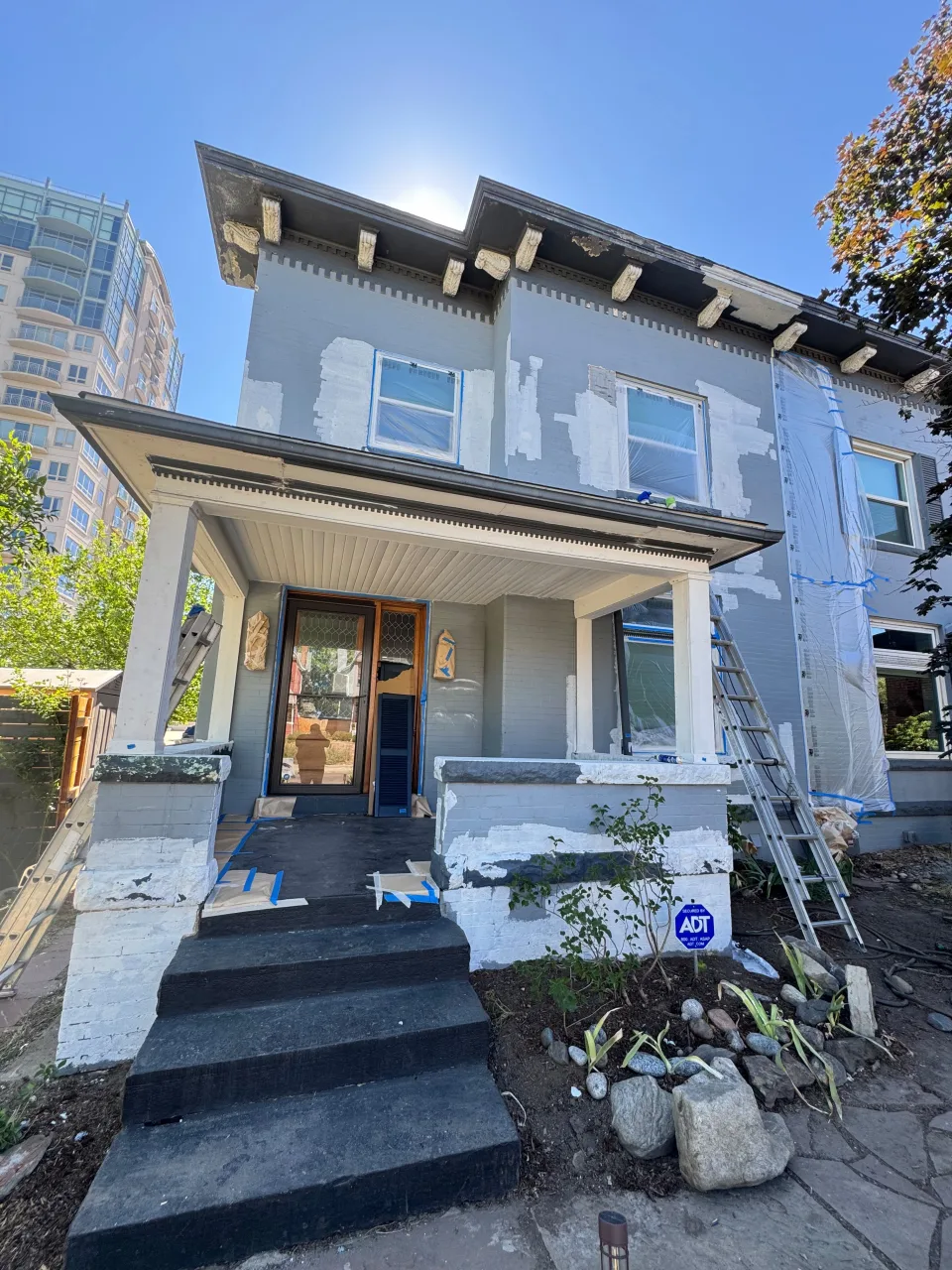
Paint does not fall off good brick for no reason. On this house, three things stacked up.
The old coating had lost its grip. Century-old brick chalks. The surface gives off a fine powder, and any coating rolled on top of that powder is bonded to dust, not to masonry.
Nobody neutralized the alkalinity. Brick and mortar are alkaline substrates. A standard exterior paint applied straight over them gets attacked from underneath, and the bond fails from the wall out.
Denver's climate finished the job. The Front Range runs more than 100 freeze-thaw cycles a year and more than 300 days of sun. Water gets behind a failing coating, freezes overnight, expands, and lifts the paint off the wall. Each cycle takes a little more.
So the first decision on this project was not about color. It was about how much of the old paint had to come off before we were allowed to add anything new.
How We Painted This Brick House Exterior, Step by Step
1. Full scrape
We scraped every square foot of failing paint off the walls. Not the loose flakes. All of it, down to sound substrate. This is the step the previous crew skipped, and it is the step that decides whether the new finish lasts eight years or eight months.
2. Masonry conditioner
Once the brick was bare and open, we applied Sherwin-Williams Loxon Conditioner. It penetrates the masonry and binds the light chalk and dusting on the surface, so the primer has something solid underneath instead of powder. It resists alkali and efflorescence, applies down to 40°F, and recoats in three hours.
3. Masonry primer
Next came Loxon Concrete & Masonry Primer/Sealer. <mark>Loxon Primer/Sealer tolerates substrate pH from 6 to 13, which is why it works on old brick and mortar where a standard exterior primer fails. It seals the porous surface and stops alkali in the wall from attacking the topcoat.</mark>
4. Two coats of exterior acrylic
The finish is Sherwin-Williams Latitude Exterior Acrylic with ClimateFlex Technology. <mark>Latitude applies at air, surface and material temperatures from 35°F to 120°F and resists moisture within 30 minutes of application.</mark> On a Denver exterior that matters twice: the south and west walls hit surface temperatures far above air temperature by noon in July, and an afternoon storm in September can arrive an hour after you pull the last coat.
We still hold our own rule for exterior work, which is a different thing from what the can allows. See the FAQ below.
5. Trim, porch and detail
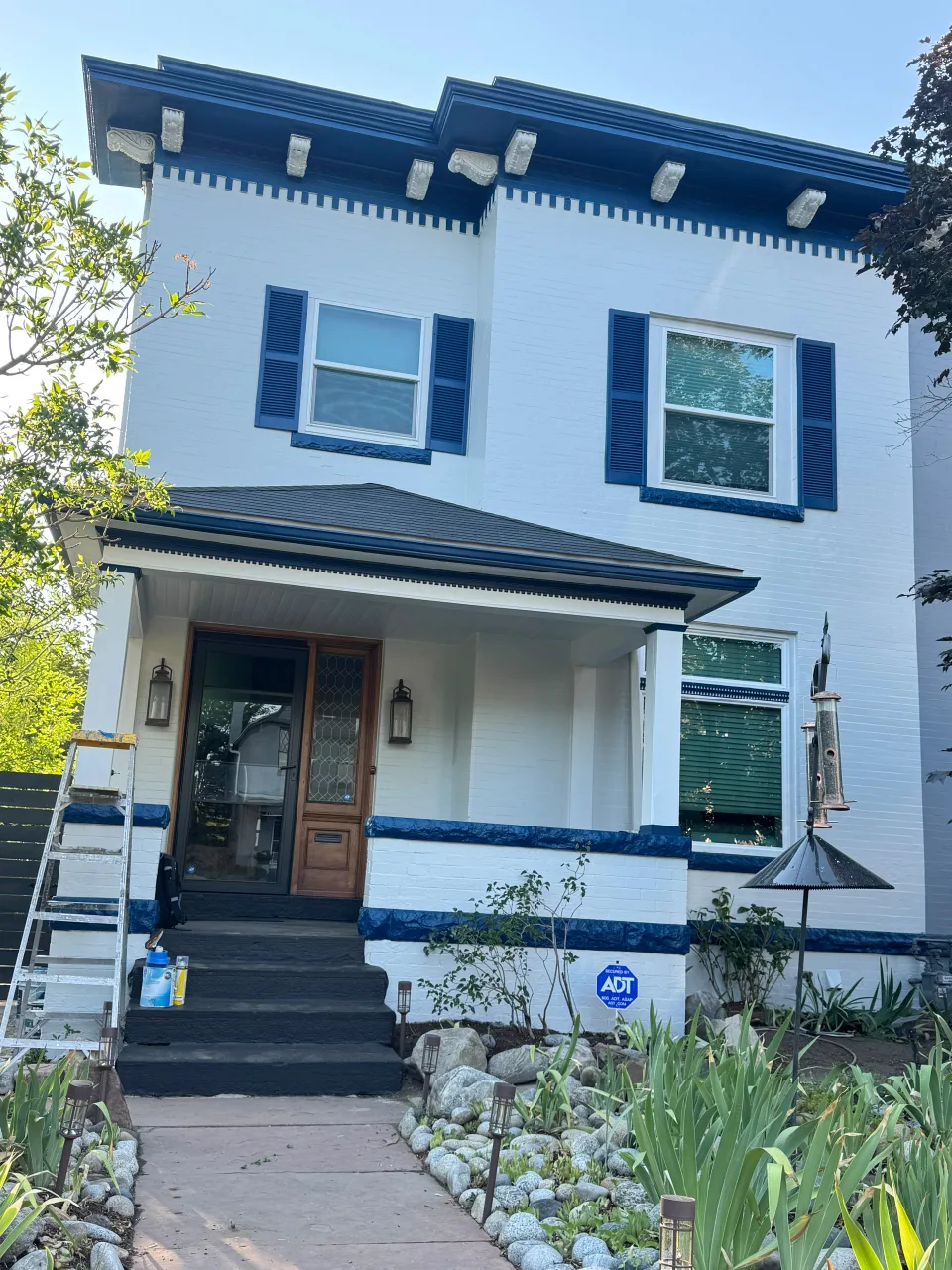
White field brick, deep navy on the cornice, shutters, window trim and porch banding, dark charcoal on the steps and porch floor. Every corbel and every run of dentil molding was cut in by hand. There is no spray shortcut on Victorian and Edwardian detail work.
6. Inside the house
Most of this project was exterior. Indoors we handled a set of drywall repairs and finish work, then patched, textured and painted so the repairs disappeared under side light.Is It Better to Paint Brick With a Roller or Brush?
For big wall areas, a roller or sprayer covers far more ground than a brush. The challenge with brick is texture: paint has to reach into the pores and the recessed mortar joints, or you end up with pinholes and thin spots. Most professional crews spray or use a thick-nap roller, then work the paint into the joints. A brush is for trim, sills and detail work like the corbels on this house.
The Result: Before and After
The finished house is crisp white brick with deep navy on the cornice, shutters, window sills and porch banding, and dark charcoal on the front steps. The carved corbels stayed light so the detail still pops from the street.
Best Paint for Brick Exterior: What We Used and Why
The best paint system for exterior brick in Colorado lets water vapor escape, bonds to alkaline masonry and handles big temperature swings. On this house, that meant a masonry conditioner, Sherwin-Williams Loxon masonry primer and Sherwin-Williams Latitude, working together as one system.
Breathability is the part people don't expect. Brick walls hold moisture, and in a Colorado winter water vapor moves from the warm inside of the home toward the cold outside. A coating that seals brick like plastic wrap traps that vapor in the wall, and once it freezes, the damage begins. A breathable masonry system lets the vapor out while keeping rain from soaking in.
ProductWhat it doesWhy we used it hereMasonry conditioner Firms up leftover chalk and dustThe brick surface was loose after scrapingSherwin-Williams Loxon masonry primerSeals porous brick, handles alkalinity (pH 6–13)Old brick and mortar are alkalineSherwin-Williams Latitude exterior acrylicFinish coats, applies from 35°F to 120°FBuilt for Denver's heat, cold and quick stormsIs Painting Exterior Brick a Good Idea?
It depends on two things: whether your brick is already painted, and how old it is. Here's how we look at it after a job like this one.
If Your Brick Is Already Painted
Repaint it, the way we did on this house. Stripping old brick back to bare tends to damage the brick along with the paint, so the real question is how to repaint brick so it lasts this time.
If Your Brick Is Historic and Unpainted
If your home goes back before the 1940s and the brick has never been painted, our honest advice is usually to leave it that way. Older brick is softer and needs to breathe, and Denver Landmark Preservation recommends keeping historically unpainted masonry unpainted. The wrong coating traps moisture, and in a freeze-thaw climate that can pop the face off the brick, which masons call spalling.
If Your Brick Is Newer and Unpainted
Brick ranch homes from the 1960s to 2000s, common in Aurora, Centennial and Englewood, are built with harder brick that can take paint, as long as the wall is dry, there's no white powdery residue (efflorescence) coming through, and the mortar is solid.
Things to Consider Before Painting Over Brick
Painted brick needs repainting down the road, it's hard to reverse, and the wrong product can trap moisture. In exchange you get a fresh look, better curb appeal and an extra layer of protection from the weather.
ProsConsUpdates a dated or mismatched facadeHard to remove once appliedAdds a protective layer against weatherNeeds repainting over timeCovers stains and patchy repairsThe wrong product can trap moistureBoosts curb appeal before a salePoor prep leads to peeling, like this houseHow Long Does Painted Brick Last in Colorado?
With premium products and real prep, exterior paint here typically lasts 8 to 12 years. South and west walls wear first because that's where high-altitude UV hits hardest. Skip the scraping and the masonry primer, and it can fail in a fraction of that time. This house is proof.
How Much Does It Cost to Paint a Brick House in Denver?
Exterior painting in the Denver metro runs about $3.50 to $6.10 per square foot of wall surface, and a typical single-family repaint lands between $5,200 and $11,400. A house like this one, with failing paint and a lot of detail, sits toward the higher end because of the scraping and priming involved.
What you're paying forDenver metro rangeExterior painting, per sq ft of wall$3.50 – $6.10Typical single-family repaint$5,200 – $11,400Time on site, 2,000–2,800 sq ft home4 to 7 working daysThree things move the price on brick: how much old paint has to come off, how much detail your home has, and how many colors you choose. Our estimates are written line by line, so you can see exactly what goes to prep and what goes to paint.
Get your free written estimate: (786) 545-6631
What We Don't Do on Brick
We'd rather be upfront than waste your time on an estimate that doesn't fit:
- We don't repoint mortar or rebuild brick. Tuckpointing, replacing brick and resetting stone is a mason's job. We paint brick that's structurally sound.
- We don't strip paint off soft historic brick. Removal usually damages the brick more than the paint ever did.
- We don't paint over active water. If water is getting into the wall, the leak gets fixed first. Paint would only hide it for a season.
- We don't take commercial jobs. Our work is 100% residential.
Brick House Painters Serving Denver, Aurora and Centennial
If your paint is peeling, chalking or coming off in sheets, the wall is telling you something about the last job. We give written estimates broken out by line, so you can see what you are paying for preparation and what you are paying for paint.
Call (786) 545-6631 or request an estimate online. We serve Denver, Aurora, Centennial, Englewood, Parker, Lone Tree, Highlands Ranch, Greenwood Village, Castle Rock and Castle Pines.
Learn more about Exterior House Painting →